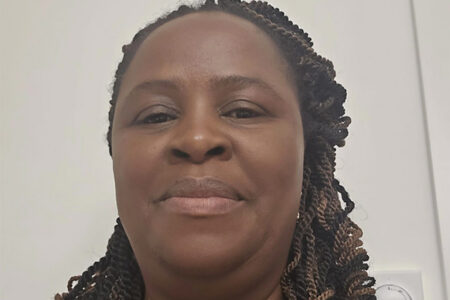
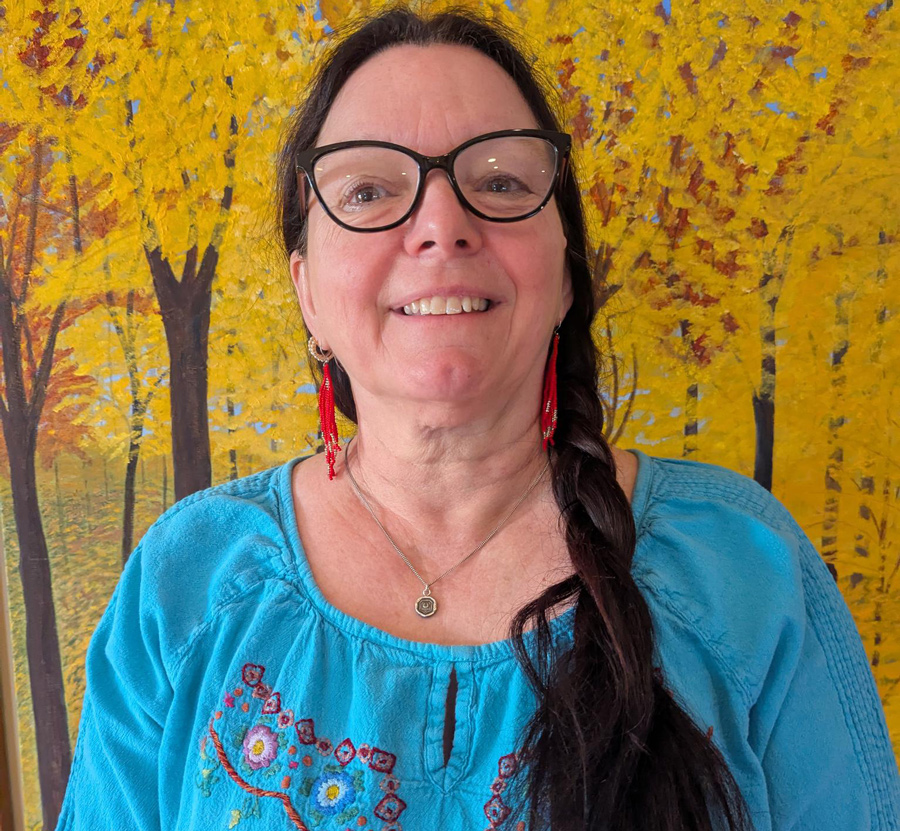
After 35 years working in a male-dominated industry, Suzan Philippe made a decision that would change the trajectory of her career. At 58, she enrolled in Yorkville University’s Master of Education in Adult Education program – not to retire from her present occupation, but to ensure that all the knowledge she’d accumulated over that time wouldn’t be lost.
“I have 35 years of field experience in the Hazmat industry as a female, which is not a task for a featherweight,” said Philippe, who works as Principal at Hygienica Environmental, a consultancy firm specializing in environmental hygiene safety including asbestos, lead, mould, and silica assessment.
“So, I thought, ‘You know what? I can’t take this to the grave. I would like my retirement to include teaching and training – sharing my decades of experience within training programs for adults seeking careers in the skills trades industry.”
Philippe’s journey to the classroom began in 1987 when she graduated from a Northern Ontario college with a diploma in Environmental Biology. From there, she carved out a unique career path that took her from blood typing race horses to freshwater taxonomy, eventually landing in the specialized field of hazardous materials, including microscopy analysis, environmental building sampling, conducting health and safety assessments and writing management programs to keep workers, staff and building occupants safe while at work or living in their home.
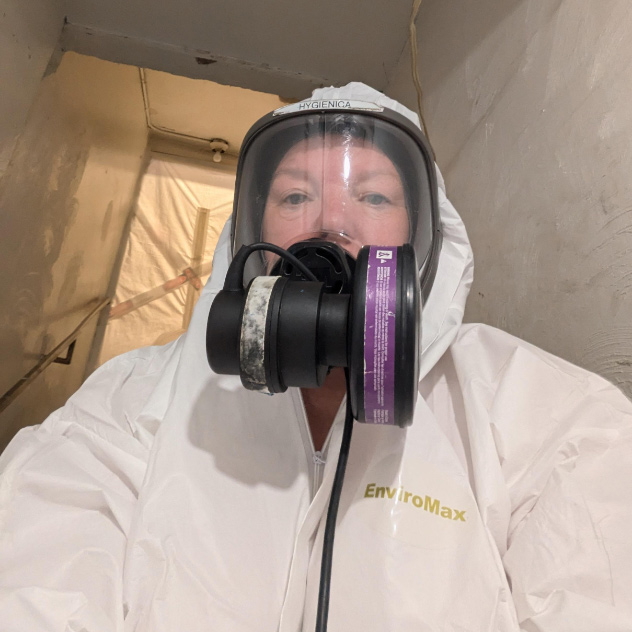
Throughout her career, she’s conducted training sessions for various groups – from construction workers in field trailers to conservators restoring totem poles – and consistently received the same feedback: her real-world experience resonated in ways that textbooks couldn’t match.
“My students would always say, ‘You are really good at teaching. You have so much field experience – it’s not just textbooks, and I can relate to so many of the situations you have brought up,’” she recalled.
It was that type of positive feedback that ultimately led her to pursue her Master of Education in Adult Education at Yorkville.
But her return to the classroom wasn’t all smooth sailing – the first two weeks of the program especially tested her resolve. “I remember when I started the first course, Foundations of Adult Education, and I thought ‘What have I done? I don’t understand this academic language, and I am struggling to relate to my peers,’” she admitted.
Then her phone rang – it was one of her professors calling to check in. “I just burst out crying and I said, ‘I can’t do this.’ And she said, ‘Oh yes, you can,’” Philippe remembered.
“I have to tell you, every single prof picked me up every time I said I couldn’t do it. Yorkville is incredible.They allow you to feel vulnerable without fear of judgment, and the profs allowed for my authentic self to emerge and grow, which gave me the confidence to keep going.”
So, when an email landed in her inbox from Yorkville’s Career Services team, inviting her to apply for their Career Mentoring program, Philippe was intrigued. After deciding to apply, she discovered that the support system she found so valuable in her professors extended well beyond the virtual classroom and into the Career Mentoring program.
In an almost serendipitous pairing, Philippe was matched with Angelo Cosco, the Chair of Trades and Apprenticeship at Conestoga College. With his decades of experience teaching skilled trades, Cusco’s background perfectly aligned with Philippe’s goal of becoming an educator in the trades sector. Their mentoring relationship provided Philippe with practical insights that helped her shape her teaching approach.
“His communication skills were very practical. Clear,” Philippe said of Cosco. “His methodology was step by step – and that is how a skills trade worker learns. They often need methodical.”
Over three mentoring sessions – including an “amazing” in-person meeting where Cosco gave Philippe a tour of Conestoga College – Philippe said she gained invaluable perspective on curriculum development, classroom management, and the unique needs of skilled trades learners.
One piece of advice particularly resonated: “Don’t teach to the test.”
Cosco, Philippe said, helped her understand that skilled trades workers often have complicated relationships with traditional education: “When it comes to skilled trades guys, field practices that are too academic usually won’t connect with their skills experience, and you will lose buy-in,” Philippe explained.
Philippe said she was also impressed by the Career Mentoring program’s support structure throughout the process – particularly Alumni Liaison Specialist Emma Hartley’s regular check-ins to ensure mentors were responsive and mentees felt supported.
“The outreach after graduation makes you feel so supported,” Philippe said, “because I tell you, after the classes are done, it can feel as though you are suddenly on your own , and the support disappears the moment classes end, but not at Yorkville – continued support is available if you are seeking help with career development.”
Philippe said the impact of both her in-class learnings during her graduate studies at Yorkville, coupled with her experience in the university’s Career Mentoring program became quickly evident when she returned to teach a group of doctors.
The health and safety professional who hired her noticed an immediate difference: “The confidence is an A+, as is your engagement with every single person in the room,” the professional told her. “You having your masters, really does enhance your ability to teach effectively.”
Philippe’s dream now is to establish accessible certificate programs in microscopy and environmental assessment – potentially through a continuing education program at a college like the British Columbia Institute of Technology (BCIT). She envisions week-long certificate courses that could provide career pathways for Indigenous, diverse and marginalized learners without the intimidation of multi-year degree programs.
“Let me offer you a week course,” she said, outlining her vision. “We’ll do a course in microscopy. We’ll do a course in mould assessment. We’ll do a course in building assessments.”
For mature students considering returning to school, Philippe’s advice is simple but powerful: “Twenty seconds of courage. And just go. And know that you will be fully supported along the way. Yorkville really is about seeing you graduate.”
As for Philippe, she’s now all set to walk across the stage at Yorkville’s June 2026 convocation in Fredericton, where she’ll be wearing Indigenous regalia and beaded earrings she made herself – a celebration not just of her academic achievements, but of a journey that has equipped her to pass on decades of hard-won knowledge to the next generation.